
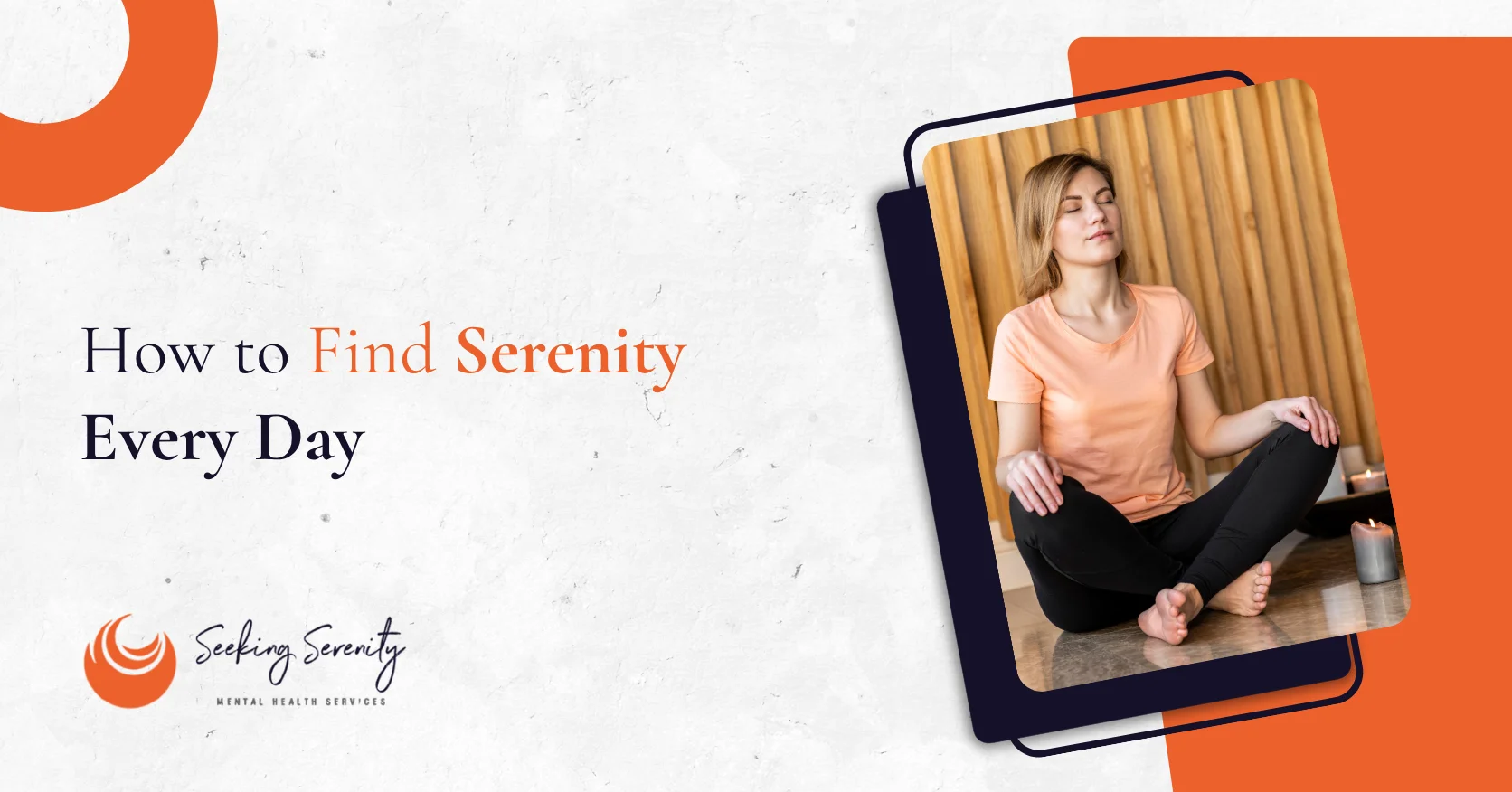
Nobody is actually waiting for things to calm down before they feel better. Or, well, they are, but things don’t calm down. The project ends and another one starts. The kids grow up and a different set of worries shows up. If serenity only exists on the other side of a resolved problem, you’re going to be waiting a long time.
The version that actually fits inside a real life is smaller and less photogenic than the one on wellness accounts. It’s not a retreat or a routine that takes ninety minutes. It’s a few things, repeated, that keep you from completely losing the thread.
You Can’t Think Your Way There
It can be hard when we are stressed not to try to talk ourselves through it. Identify the issue, create a strategy, solve the problem.
Sometimes that works. Sometimes that works. But when the anxiety isn’t one problem that we simply try to solve, when it’s just the collective burden of all things, then thinking harder doesn’t get it to move. In those moments, the body reacts quicker than the mind. A longer exhale, taking more time than an inhale, dial the stress/dial down.
It directly activates your parasympathetic nervous system. A similar thing happens when you pour cold water on your wrists. A couple of minutes outside reduces cortisol in a manner that sitting inside cannot.
The Morning Belongs to You First
Most people hand their morning to their phone before they’ve had a full thought. News, notifications, messages, someone else’s emergency landing in your brain before you’ve even had coffee. That sets a tone that sticks.
Even ten minutes before any of that is something. Not a full meditation practice, just a window where nothing is coming at you yet. Coffee outside. Sitting quietly. Reading something that has nothing to do with work or current events. The specifics don’t matter much. What matters is that something in the morning belongs to you before it belongs to everyone else.
Get It Out of Your Head
Anxious thoughts loop. They don’t resolve by being thought more carefully, they just keep circling. Writing them down actually interrupts that. Not because journaling is magic, but because your brain treats written things differently than held things. Once it’s on paper, some part of your nervous system stops working so hard to remember it.
You don’t need a journal. The notes app works. The back of an envelope works. Just get the thing out of your head and somewhere external. What you’re worried about, what you keep forgetting, what’s been sitting on your chest. Even two sentences. It helps more than it should.
Your Attention Is Getting Stolen
Scattered attention feels terrible. Hard to describe exactly, but you know it when you’re in it. Can’t settle. Keep picking up your phone for no reason. Fifteen tabs open, no task finished. That state is partially engineered. The apps on your phone are specifically designed to keep pulling you back, and they’re very good at it.
- Notifications off for anything that isn’t a person trying to reach you
- Check email at set times rather than whenever it arrives
- Phone in another room for part of the evening
None of that solves the underlying stress. But it stops the constant interruption that makes stress feel worse than it already is.
Figure Out What Actually Helps You
There’s a difference between what you do when you’re depleted and what actually restores you. Scrolling counts as neither rest nor recreation but it’s what most people default to because it requires nothing.
Worth asking for real: what do you come back from feeling better, not just less bored? Some people it’s physical, a walk, cooking, time outside. Some people it’s one good conversation. Some people it’s an hour of complete quiet with no input at all. Whatever your answer is, you probably know it already. The problem isn’t usually not knowing. It’s not protecting time for it before you hit empty.
When It’s Bigger Than a Daily Practice
Small habits go a long way. But they don’t reach everything. Anxiety that won’t settle no matter what you do, depression that keeps pulling the floor out, mood that swings without a clear reason, those things don’t respond to better morning routines. They need actual care.
There’s no amount of journaling that treats a clinical anxiety disorder. That’s not a judgment on the journaling. It’s just a different category of problem.
Seeking Serenity Can Help
Awa Ndiaye, PMHNP, FNP, is dual-board certified as both a Family Nurse Practitioner and a Psychiatric-Mental Health Nurse Practitioner, with fifteen years across hospitals, primary care, and psychiatric clinics. At Seeking Serenity, the approach is built around the whole person, not a symptom list, with psychiatric evaluation, medication management, and care that actually fits your life.
Telehealth appointments are available so you don’t have to rearrange your week to access care.
If daily serenity has felt genuinely out of reach for a while now, that’s worth talking to someone about.
Phone: (614) 636-4110
Email: seekingserenity10@gmail.com
Location: 740 Lakeview Plaza Blvd, Worthington, Ohio 43230
Website: seekingtheserenity.com
Find your peace.

No comment