
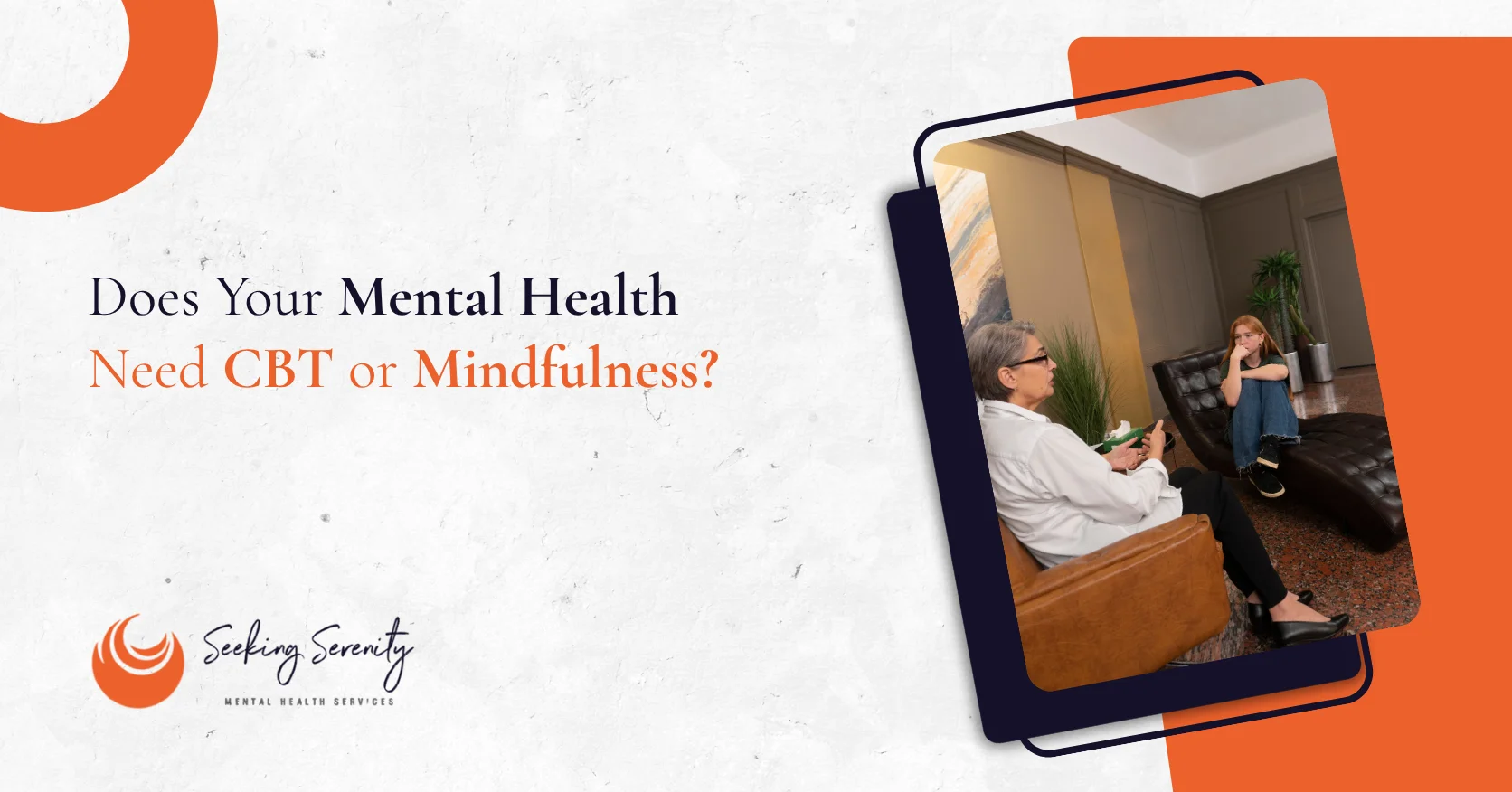
When stress, worry, sadness, or stagnation takes hold, finding relief becomes a priority.
Two of the most effective evidence-based tools, CBT or mindfulness, can offer significant support. While both are powerful, they work in distinctly different ways.
At Seeking Serenity, we don’t believe in one-size-fits-all solutions. We take time to understand your unique symptoms, health history, daily routines and personal goals. Only then do we help you determine whether CBT, mindfulness, or a blend of both is the right path forward.
Let’s explore each approach in detail.
What Is CBT?
CBT means Cognitive Behavioral Therapy. It is a type of therapy that helps you understand your thoughts, feelings, and actions.
What you think affects how you feel. Your emotions affect your actions.
You might make a tiny error at work. You may think, “I always do things wrong.” This notion may cause sadness or anxiety. You can quit trying.
CBT raises awareness of such thoughts. Learn to enquire if a thought is true or beneficial.
You may learn to replace unhelpful thoughts with balanced ones.
Mental health issues like anxiety, sadness, stress, and fear can be treated with CBT.
What Is Mindfulness?
Mindfulness means paying attention to the present moment.
You often think about the past or future. May worry about tomorrow. You may recall yesterday’s events.
Meditation brings you back to the present.
Sitting motionless and breathing is a simple mindfulness activity. Observe each breath. If your attention wanders, slowly return to your breath.
Mindfulness is not thoughtlessness. The thoughts will arrive. Recognize them without self-judgment.
When concerned, worried, upset, or unable to relax, mindfulness may assist.
Key Differences Between CBT and Mindfulness
Both of these work for mental health, but they each have different mechanisms for improving your mental health.
- Action vs. Acceptance
CBT is about taking action. CBT instructs you to evaluate and conquer negative thoughts.
Mindfulness is about acceptance. When you have a bad thought, mindfulness asks you to notice it. Accept that it’s there, then let it float away. Don’t fight it.
- Connect to the Past, Future, or Present
CBT looks at thoughts that might come from your past habits or future fears so you can fix your self-talk.
Mindfulness is simply paying attention right here, right now. It does not worry about five minutes ago or tomorrow morning.
- Active Thinking vs. Quiet Watching
In CBT, you learn to solve problems. You write your thoughts and practice new habits. This helps your brain.
Mindfulness is a place where your mind is quiet. You listen to your breath, feel your feet on the floor and observe your mind like a quiet observer.
When You Might Need CBT
CBT may help when your thoughts make daily life hard.
You may need CBT if you often:
- Think about the worst outcome
- Worry a lot
- Put yourself down
- Avoid things because you feel afraid
- Feel stuck in negative thoughts
- Have trouble dealing with stress
- Feel sad for long periods
- Have trouble changing old habits
CBT gives you tools that you can use in daily life.
The goal is not to think happy thoughts all the time. The goal is to learn healthier and more balanced ways to think.
When You Might Need Mindfulness
Mindfulness may help when your mind feels busy or overwhelmed.
You may have many worries about:
- Work
- Family
- Money
- School
- Relationships
- Daily life
Mindfulness gives you a chance to pause.
You can take a moment to focus on your breath. You can become aware of your physical sensations. You can observe your thoughts without resistance.
For example, instead of thinking: “I can’t manage this.”
You might say: “I feel anxious right now.”
This small change can help you pause before you act. It can give you time to understand what you are feeling.
Combining CBT and Mindfulness
You don’t have to choose one. In fact, CBT and mindfulness work well together! Many mental health experts use both in a method called Mindfulness-Based Cognitive Therapy.
Begin by practicing mindfulness to recognize when stress arises. Take a moment to breathe and concentrate on your body. After calming your mind, apply CBT to examine the thoughts that trigger your stress.
Combining these helps you stay calm while tackling the root issue.
Professional Support for Your Mental Health Journey
Trying to fix your mental health alone can feel confusing. You do not have to guess what your mind needs. Professional guidance makes finding peace much easier.
Seeking Serenity offers compassionate telehealth services led by Awa Ndiaye, a dual-board-certified nurse practitioner. We provide:
- Personalized psychiatric evaluations
- Holistic care
Whether you need:
- CBT to shift unhelpful patterns
- Mindfulness to ground your mind
- Specialized care like family counseling and individual therapy
Having an expert can help you create a treatment plan that fits your life perfectly.
Final Thoughts
Your mental health is important. Choosing either CBT or mindfulness is definitely a courageous move. You’re telling yourself, “I deserve to feel better. And you do.
If you’re not sure which one might be best for you, you can get clarity when you have a mental health evaluation with a professional.
At Seeking Serenity, we focus on comprehensive care that respects the individual. We provide psychiatric evaluations, medication management and a wide range of mental health support through telehealth across Ohio.
Contact us for the support you deserve.
FAQs
How long do results from CBT or mindfulness take?
It depends on each person. CBT is typically temporary. Many notice certain changes within 2-4 weeks or months. Mindfulness can provide instant relief from a sense of calm. But the benefits grow the more you practice.
Can I do CBT or mindfulness without a therapist?
It’s preferable to do CBT with a skilled therapist. They can teach you the skills and guide you. You can practice mindfulness by yourself. But a therapist can help you dive further into it.



No comment