
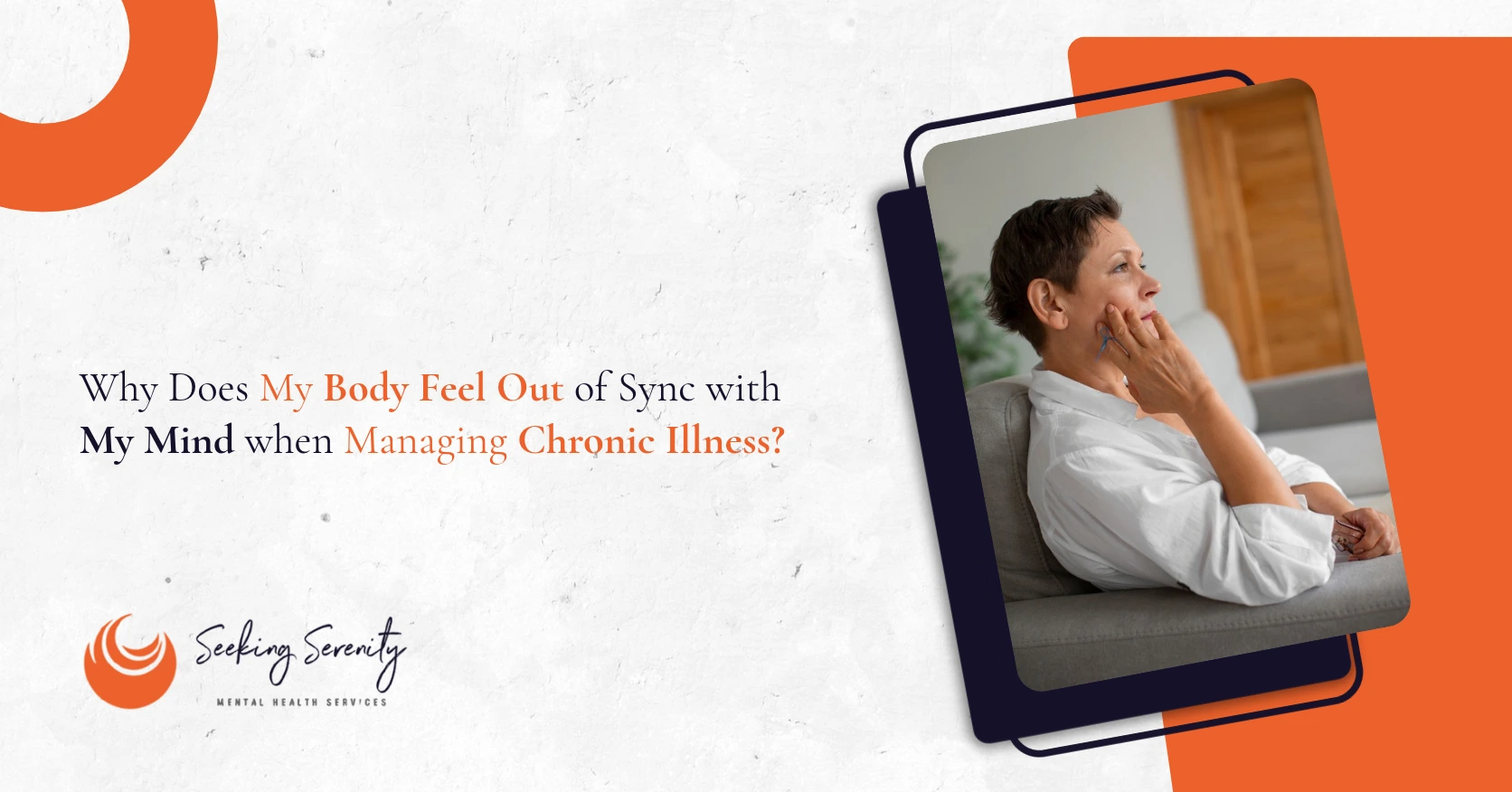
Your body and mind can feel out of sync because chronic illness changes how your brain reads body signals. Stress, inflammation and constant symptom tracking overload the nervous system. This can make it difficult to live by your instincts and intuition. You are not imagining this because it’s so present right now. It is a real physical reaction to chronic illness.
At Seeking Serenity, we understand this struggle. We have specialized psychiatric care in Worthington, Ohio, for patients with medical complexity. Our work goes hand in hand with your regular physicians and specialists, and your physical and mental health treatments support each other.
What Does the Mind-Body Disconnect Feel Like?
It feels like your body is doing one thing while your mind is somewhere else. You may feel numb. It can feel like you’re watching yourself from the outside of your body.
Some have said, “I don’t feel this body is my body”. Others confess, “I can’t tell the difference between drowsiness, sadness, or sickness”. These are common words used by people with long-term conditions.
This disconnect can show up in small ways every day:
- You might not notice hunger until you feel shaky
- You might not feel a fever until it’s very high
- You might push through pain without realizing it, then crash later
Your mind and body aren’t talking to each other clearly and that’s not your fault.
Why the Disconnect Happens in Chronic Illness
Your Brain’s Signal Reader Gets Tired
Your brain has a special part that reads signals from your body. It is called the insula. This part helps you feel hunger, heartbeat, nausea and pain. In people with chronic illness, the insula can change.
Research shows that people with long-term disease have lower insula volume and unusual insula activity compared to healthy people. This means the brain may misread body signals. It may overreact to small things or underreact to big things.
Your Nervous System Stays on High Alert
Chronic illness puts your body in a state of constant stress. Your nervous system never fully rests. This is called dysregulation. When this happens, body signals get mixed up:
- Your heart may race for no clear reason
- Your digestion may slow down or speed up
- Your temperature control may stop working well
This is due to prolonged activation of the sympathetic nervous system with an inability to activate the parasympathetic system (balance) in the body.
You May Have Trouble Naming Feelings
Some people with chronic illness have a hard time knowing what they feel. This is known as alexithymia. It describes a lack of emotional self-awareness and self-expression. It’s not a “Fault”. It is not a brain deficiency but rather a difference in the brain.
Studies show alexithymia is much more common in chronic pain conditions. Up to 48% of people with fibromyalgia show signs of it, compared to only 6 to 8% of the general population. When you cannot name a feeling, your body may hold it instead.
The Mental Health Toll Is Real
The mind-body disconnect doesn’t happen in a vacuum. It’s tied to real emotional strain.
Recent CDC data reveals:
- 60% of people with chronic conditions feel stressed by managing their health
- Half say it impacts their mental health
- Nearly two-thirds of chronic pain sufferers experience anxiety or depression symptoms.
- About 30% of people with a long-term physical condition also have a mental health problem
This is not a sign of weakness. It’s a sign that your body and mind are carrying a heavy load at the same time.
How to Bring Your Mind and Body Back Together
It takes time to feel better. Small steps can help you feel calmer and more in touch with your body.
Here are some simple things you can try:
- Take slow, deep breaths. This tells your body it is safe.
- Rest, even if it feels strange. Rest is not lazy. Rest helps you.
- Move gently. Try easy stretches or a slow walk. Do not push hard.
- Talk nice to yourself. Your body is working hard for you.
- Rest before you crash. Take small breaks all day.
Finding Support in Worthington, Ohio with Seeking Serenity
Living with a chronic illness is a long journey. Some days are good. Some days are hard. You do not have to do it alone.
Seeking Serenity provides online mental health care to people in Worthington, Ohio. Awa Ndiaye is a psychiatric nurse practitioner who deeply understands the overlap between physical and mental health.
We specialize in helping people who deal with medical complexity. We focus on:
- Psychiatric evaluation and medication management
- Treatment for depression, anxiety, panic and mood instability
- Medically guided weight loss support
- Coordinated care for medical complexity
You can have visits by phone or video. You do not have to drive to a clinic when your body hurts.
FAQs
Is it normal to feel away from my body when I have a long-term illness?
Yes. Some people with long-term health problems feel this way. Stress, pain, and tiredness can make it harder to understand your body’s signals.
Can this feeling get better?
Yes. It may get better with time and care. Slow breathing, gentle movement, rest and mental health support may help.
Does Seeking Serenity only care for mental health?
No. Seeking Serenity looks at both your body and mind. We help people who have mental health needs along with long-term health problems.
Can mental health care help with body pain?
It can. Tending to stress, anxiety, and sadness can help you deal with pain. It can also help you relax and sleep. Mental health care works best when it is part of overall medical care.
Your Next Step to Finding Peace
You deserve to find peace and balance.
Visit Seeking Serenity to learn more about medical complexity care, medication management and telehealth support anywhere in Worthington, Ohio. We are ready to listen to your story and build a care plan designed specifically for you.




No comment