
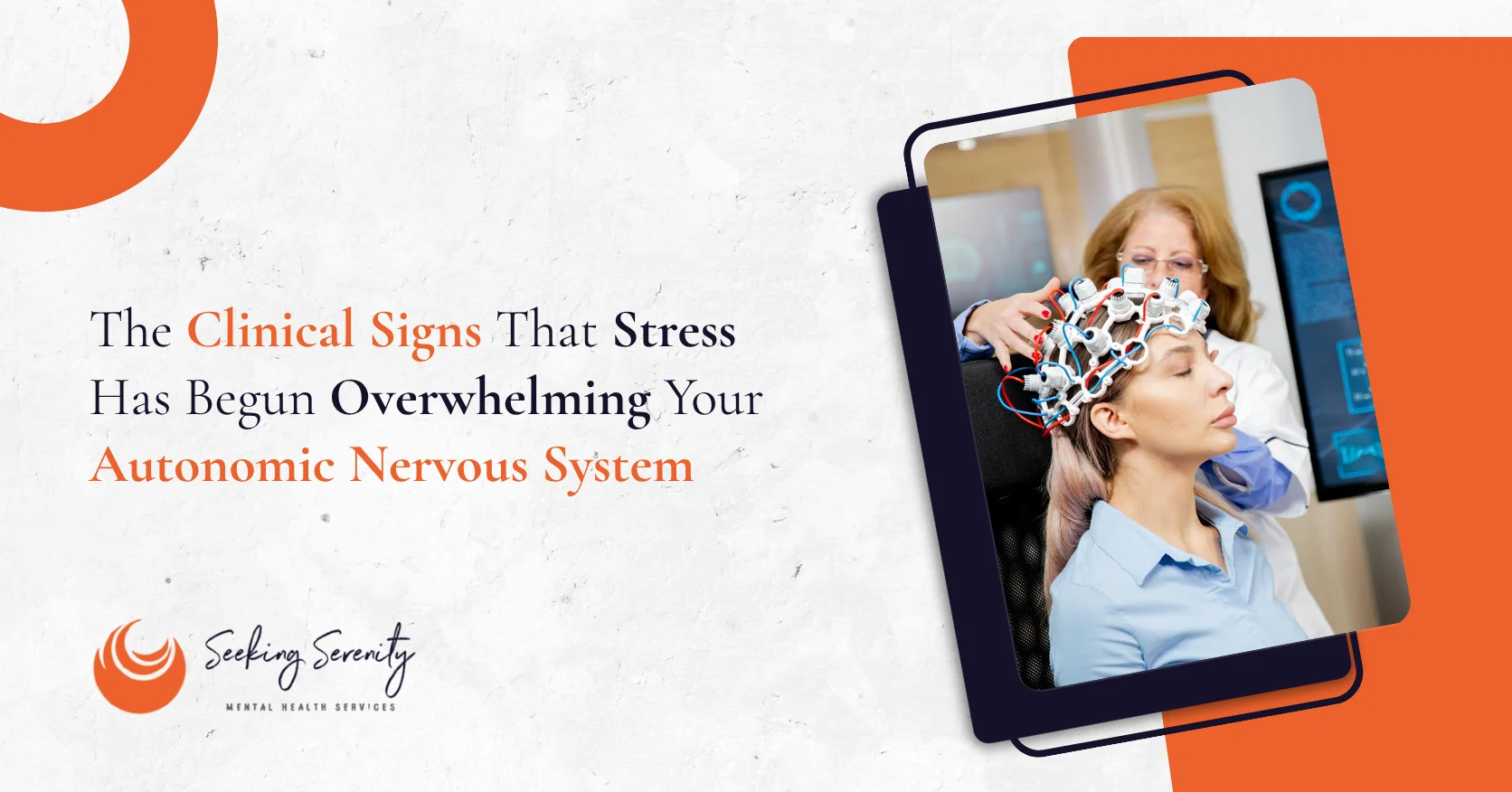
Everyone knows what stress feels like. The tight chest before a hard conversation. The sleep that goes sideways when your mind refuses to quiet down. The low-grade exhaustion that a weekend off never quite fixes. We have normalized all of it to such a degree that most people treat chronic stress the same way they treat bad weather: unpleasant, temporarily, and ultimately something you just get through.
But there is a point at which stress stops being a mood and starts being a physiological event. And once your autonomic nervous system gets pulled into it, the symptoms stop being psychological and start showing up in your body in ways that have nothing to do with how stressed you feel on any given day.
That distinction matters a lot, and most people miss it entirely.
What The Autonomic Nervous System Is Actually Doing
Before we get into the signs, a quick grounding in what we are actually talking about. Your autonomic nervous system is the portion of your nervous system that operates on its own, without your awareness. The rate of the heart, the rate of digestion, the rate of breathing, the dilation of the pupils, and the production of secretions by the glands. It is carried out through two main streams designed to be counterbalanced.
Sympathetic means activation. Fight or flight. It raises your heartbeat, diverts blood flow to muscles, slows food digestion – and adds cortisol and adrenaline to your blood. It’s really handy for brief periods of time. It was made for short duration.
Your recovery system is the parasympathetic branch. Rest and digest. It slows your heart rate, triggers digestion, lowers blood pressure, and brings your body back to a normal equilibrium.
These two branches of the nervous system are always in dialogue with each other in a healthy, well-regulated nervous system. The sympathetic portion is activated with stress. Rest returns you to the parasympathetic branch. The problem comes from when chronic stress continually engages the sympathetic nervous system for extended periods, to the point where the sympathetic nervous system cannot keep up anymore, and parasympathetic nervous system becomes overwhelmed. The system goes into a state of high alert. This is dysregulation and it has real measurable consequences.
The Signs That Your System Has Crossed A Line
Your Heart Rate Does Things It Should Not
One of the most obvious physiological cues that your autonomic nervous system is under chronic stress is a lack of heart rate variability (HRV), or a decrease in HRV. When the autonomic nervous system is healthy, there is a natural variation between beats. Dysregulating your system will cause that variability to level off. Rapidly standing up causes your heart to beat faster. You experience it during situations that wouldn’t have caused it earlier. You notice palpitations when you are lying still. These are not cardiac problems that need to be occurring. They can be completely over the top due to a hyperactive nervous system.
Digestion Becomes Unpredictable
The gut and the brain are in constant communication through the vagus nerve, one of the primary conduits of parasympathetic function. When your sympathetic nervous system is dominant for extended periods, digestion suffers directly. Blood flow is deprioritized from the digestive tract. Motility slows or becomes erratic. This is why chronic stress reliably produces symptoms like nausea without a clear cause, irregular bowel function, bloating that does not respond to dietary changes, and a general sensitivity in the gut that was not there before.
If you have been chasing a GI diagnosis and coming up empty, dysregulated autonomic function is worth putting on the table.
You Cannot Get Warm, Or You Cannot Cool Down
Thermoregulation is autonomically controlled. When the system is dysregulated, temperature regulation goes with it. Some people describe running cold all the time, despite being in warm environments. Others report sweating disproportionately, particularly at night or in response to minor stressors. Neither of these is unusual as an isolated occurrence. As a persistent pattern alongside other symptoms, they are meaningful data.
Sleep Becomes Structurally Broken
We are not talking about lying awake because you are worrying, though that happens too. We are talking about sleep that does not restore you even when you get enough of it. Waking between two and four in the morning without a clear reason. Difficulty transitioning into deep sleep. Dreams that feel more like work than rest. These patterns reflect what happens when your cortisol rhythm gets disrupted by sustained sympathetic activation. Cortisol is supposed to be lowest at night, rising toward morning to pull you into wakefulness naturally. Chronic dysregulation scrambles that curve. You end up wired when you should be winding down and foggy when you should be alert.
Your Threshold For Everything Gets Lower
This one is harder to quantify but clinically important. People with autonomically dysregulated nervous systems often notice that their tolerance for sensory input drops significantly. Noise becomes intolerable. Crowds feel genuinely overwhelming. Caffeine that used to be unremarkable starts producing anxiety or heart pounding. Minor frustrations land harder than they used to. Social interaction that was once energizing now feels depleting.
What is actually happening is that your nervous system’s capacity for regulation is being used up by the chronic background load. There is less buffer left for ordinary stressors. The threshold drops because the baseline is already elevated.
- Sensitivity to light or sound that seems to have intensified over time
- A startle response that feels hair-trigger
- Feeling overstimulated in environments that did not use to affect you
- Emotional reactions that feel outsized and arrive quickly, before you can catch them
Fatigue That Does Not Track With Rest
Autonomic dysregulation produces a specific kind of exhaustion that is different from the tired you feel after a demanding week! It does not lift after a good night of sleep. It does not improve significantly over a vacation. It is a cellular-level depletion that comes from operating in a sustained state of physiological stress – where your body has been running emergency protocols for so long that even basic restoration becomes inefficient.
People often describe it as feeling tired in their bones. Or as needing more sleep than they used to, but waking up less rested. Or as having a shorter energy window in the day than their actual demands require.
Why This Is A Clinical Conversation, Not Just A Wellness One
At Seeking Serenity, Awa Ndiaye approaches exactly this intersection of body and mind. As a dual board-certified Family Nurse Practitioner and Psychiatric-Mental Health Nurse Practitioner with over fifteen years of clinical experience, she is trained to look at the full physiological picture, not just the mood layer on top of it. The whole-person model is not a brand value here. It is a clinical methodology.
Reach out today.





No comment