
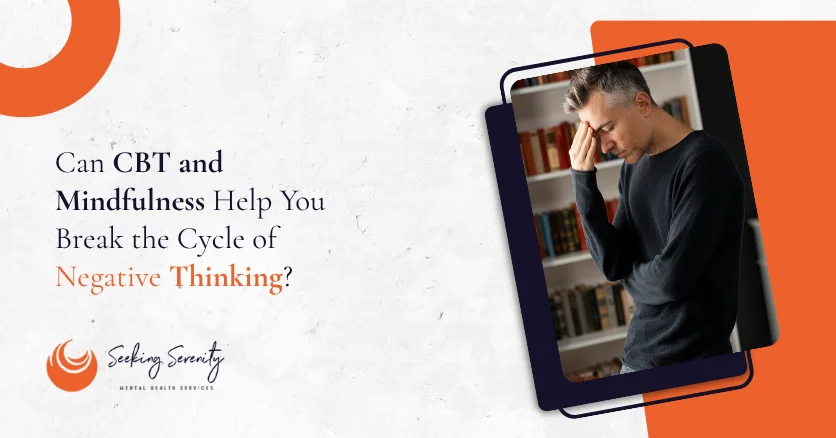
Do you feel stuck in a loop of bad thoughts? You wake up, your mind racing as you worry about a mistake from yesterday and what today holds. This loop can tire you and steal your joy, but you don’t have to remain stuck.
Cognitive Behavioral Therapy and mindfulness are two tools that can help you regain control.
Cognitive Behavioral Therapy is often called CBT. Mindfulness teaches you to change your thoughts and helps you stay in the present moment. At Seeking Serenity, we understand that tools such as CBT and mindfulness can help people manage negative thinking and emotional stress. Let us look at how they work.
What Is the Cycle of Negative Thinking?
Your brain is wired for safety. But sometimes it overreacts and looks for danger everyplace. This starts a vicious cycle. You have one negative thought and then you feel anxious and it impacts your behavior and then you have even more negative thoughts. This pattern can last for years.
Here is how the cycle happens:
- A thought appears. You think you will fail a test.
- A feeling follows. You feel nervous and sick.
- An action happens. You avoid your work completely.
- A new thought starts. You think you are not smart enough.
The loop goes round and round. It feels like a trap. But you can break it.
Examples of Negative Thinking Traps
Our minds can deceive us. These deceptions are known as cognitive traps. CBT enables you to identify these pitfalls swiftly. Once recognized, they diminish their influence on you. Do any of these typical traps resonate with you?
- All or nothing. You think everything is perfectly good or completely bad. There is no middle ground.
- Mind reading. You try to guess what other people think (which never works out well). You assume they are mad at you.
- Telling the future. You decide things will go wrong before they even happen. You expect the worst.
- Focusing on the bad. You ignore all the wonderful things that happen. You only look at the one bad thing.
Traps can distort reality, making it seem more negative, but CBT helps you recognize these patterns. It gives you a clearer view of your thoughts.
How Cognitive Behavioral Therapy Works
CBT is a highly practical tool. It’s about doing the work that changes your heart. CBT teaches that thoughts are not always facts, nor a true reflection of reality.
When learning CBT you make little steps:
- Observe the thought. You see a bad thought entering your mind.
- Verify the facts. You wonder if the thought is really true.
- Change the story. You exchange the erroneous concept for the accurate one.
If a friend doesn’t reply to your text quickly, you may worry they’re upset. With CBT, you can stop yourself and check the facts. They’re probably busy. This can help you reframe the thought and respond more calmly and more in balance.
What Mindfulness Does for Your Brain
Mindfulness is the perfect partner for CBT. It means paying full attention to the present moment, without worrying about the past or fearing the future.
When bad thoughts race through your head, mindfulness hits the pause button. You can practice mindfulness in simple ways:
- Take deep breaths. Notice how the cool air feels.
- Feel your feet. Pay attention to how your shoes feel on the ground.
- Listen closely. Find three sounds you can hear right now.
- Eat slowly. Notice the sweet or salty taste of your food.
Mindfulness can help you notice difficult thoughts without immediately reacting to them or trying to push them away. You watch the thoughts float away like clouds, soft and harmless.
Bringing CBT and Mindfulness Together
CBT and mindfulness can work well together. Mindfulness can help you slow down and pay attention to the present moment. It helps you catch bad thoughts before they get out of hand. Once you catch them, then you get CBT to help. CBT teaches you to question those thoughts and develop more balanced ways of thinking.
Think of mindfulness as a bright flashlight. It shows you where the dark, scary thoughts hide. Then, CBT acts like a broom. It sweeps the bad thoughts right out of your way. Together, they can help you interrupt the cycle. You may find it easier to manage worry and respond to negative thoughts in healthier ways.
How Seeking Serenity Can Help You
Breaking a pattern of negative thinking takes time and requires practice. At Seeking Serenity, we’re here to help you, so you are not alone in this. Intrusive thoughts can feel like a significant weight. Our tailored psychiatric care emphasizes grasping your issues and guiding you toward an appropriate way ahead.
At Seeking Serenity, we hear your story. We provide personalized care based on your concerns, needs and treatment goals. Grasping your thoughts and remaining in the moment can significantly improve your mental health. Transformation begins with that first move.
Ready to break the cycle of worry? Seeking Serenity is available to assist you in discovering your mental health care choices. Reach out to Seeking Serenity now to move forward on your journey to improved mental wellness.
FAQs
Q. How do bad thoughts get stuck in a loop?
One bad thought brings a bad feeling. That feeling changes actions. Then, a new bad thought starts.
Q. How does CBT stop bad thoughts?
CBT uses three simple steps. First, catch the thought. Next, check if it is true. Last, replace it with a more balanced thought.





No comment