
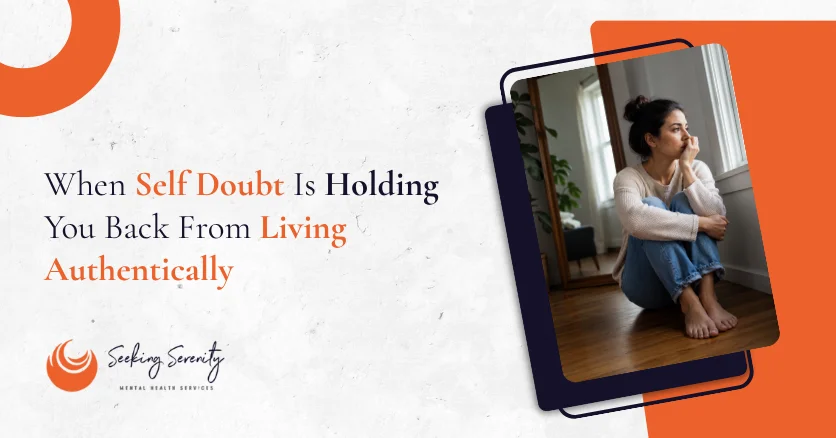
There’s a version of you that speaks up in the meeting instead of staying quiet. Takes the job instead of talking out of it.
Tells a friend the truth instead of the polite version. Most people know that version exists.
Most people also don’t let it out very often, because self-doubt got there first and decided it wasn’t safe.
It Rarely Announces Itself
Self-doubt rarely comes in the form of a sentence saying like “I do not trust myself. It’s often in a disguise, and the disguise is what makes it so elusive.
- Waiting for more information before deciding, when the information was never really the problem
- Running an idea past three people before trusting your own read on it
- Rehearsing a text for twenty minutes before sending something completely ordinary
- Saying “I don’t really have a preference” when you do, clearly, have one
None of that looks like doubt from the inside. It looks like being careful. Being thorough. Being considerate of other people. That’s exactly the trick.
Where It Actually Comes From
A lot of self-doubt has nothing to do with the decision sitting in front of you right now. It’s inherited. A parent who corrected more than they praised. A teacher whose feedback landed as a verdict on your worth instead of notes on your work. An early relationship where being wrong came with real consequences, not correction, withdrawal. Coldness. Punishment.
The nervous system learns fast. Once being wrong felt dangerous, the brain starts treating every future decision like it might be dangerous too. Long after the original danger is gone.
The Damage Isn’t the Big Decisions
People assume self-doubt costs them the dramatic stuff, the job never applied for, the relationship never pursued. True, but that’s not where most of it happens. The real erosion is smaller and constant.
- Agreeing with an opinion you don’t actually hold, because disagreeing feels risky
- Laughing at something that wasn’t funny
- Saying “I’m fine” enough times it stops registering as a lie, even to you
- Softening a real opinion into something vague enough that nobody could object to it
Authenticity rarely dies in one big moment. It gets worn down by a thousand small ones, none of which felt like a big deal at the time.
Confidence Was Never Going to Show Up First
Waiting to feel confident before acting authentically rarely works.
Confidence tends to arrive after the action, not before it.
Waiting for self-doubt to fully resolve before speaking up, before setting a boundary, before making the choice, means waiting for something that might not show up on its own schedule at all.
Action usually has to come first. Confidence catches up once there’s actual evidence to work from, not before.
What the Voice Actually Sounds Like
“Who am I to think that.” “They’re going to figure out I don’t actually know what I’m doing.” “It’s probably not that big a deal, I shouldn’t make a thing of it.”
These aren’t neutral observations. They’re a specific voice, usually old, usually borrowed from somewhere.
Naming it as a voice instead of a fact tends to be the first real shift. Not “I am not capable.” Just: there’s a voice saying I’m not capable, and it’s been saying that for a long time.
Practice, Not a Personality Trait
Nobody wakes up permanently done with self-doubt. It’s less a switch and more a rep count.
- Speaking the honest answer instead of the safe one, even in something small
- Making a decision without running it past four other people first
- Letting a silence sit instead of filling it with an apology nobody needed
- Sending the text without rereading it six times first
Each one is tiny. None of them feel significant in the moment. Stacked over months, they’re basically the whole process.
When It’s More Than Doubt
And sometimes what masquerades as simple self-doubt is something deeper. Chronic anxiety.
The depression which no longer allows you to trust your own judgement at all.
Some old trauma response that is still quietly running in the background years after the thing responsible for it. It is a distinction that matters.
If self-doubt has been present for years, if it is worsening rather than subsiding with time or if it comes with a mood that flattens all else as well, this is less a matter of mindset and indeed deserves an actual assessment.
Seeking Serenity, led by Awa Ndiaye, PMHNP FNP and Health Coach with over 15 years of clinical experience, offers psychiatric evaluations via telehealth, including support for anxiety, depression, and the patterns that quietly keep people from living the way they actually want to.
Visit seekingtheserenity.com to schedule an appointment.
No comment